Samsung's November 2026 Galaxy Update Fixes the Modem Flaw Exploited on Pixel: Is Your Galaxy Affected?
TL;DR
- Google fixed modem flaw CVE-2026-58704 on Pixel on September 15; Samsung added the same fix to its Galaxy bulletin 49 days later, on November 3.
- The flaw is in Samsung Exynos chips. Of the 70 Galaxy phones safeuntil tracks that still get updates (as of November 4), 25 have a sales version with an affected chip.
- On November 4, Samsung's release notes showed no November patch yet for any of the 70 Galaxy phones safeuntil tracks on the update lists. From January to October, half of monthly-list phone updates came within 16 to 23 days of the bulletin, depending on region.
Google fixed CVE-2026-58704, a modem flaw that may have been exploited against Pixel phones, on September 15. Samsung added the same fix to its Galaxy security bulletin (SMR1 Nov-2026) 49 days later, on November 3. The flaw is in Samsung's Exynos chips, so the same Galaxy model can be affected in one country and not in another. A bulletin is not an update on your phone. On November 4, Samsung's release notes showed no November patch yet for any of the 70 Galaxy phones safeuntil tracks on the update lists.
When the modem flaw was found and fixed
NVD, the US vulnerability database, describes CVE-2026-58704 as a logic error in cellular modem code that skips a permission check. A nearby attacker can gain higher privileges without any action by the user.
- September 15: Google published the fix in its Pixel bulletin and said there are indications the flaw may be under limited, targeted exploitation.
- September 16: CISA2 added it to its catalog of exploited vulnerabilities. The entry names only Google Pixel as the product.
- September 23: Samsung Semiconductor's page says the flaw was reported to the company on this date.
- November 3: the fix first appeared in Samsung's Galaxy bulletin, under chip fixes. Of Samsung's 2026 bulletins from January to November, only the November one lists it.
Samsung Semiconductor lists the affected chips: its Exynos processors 850, 1280, 1330, 1380, 1480, 1580, 1680, 2200, 2400, 2500, 9110, W920, W930 and W1000, and its cellular modem chips 5123, 5300, 5400 and 5410. A Galaxy phone with a Qualcomm Snapdragon chip is not affected.
Samsung does not say which Galaxy models use these chips. So I looked up each model's chip name in the spec pages and press releases that Samsung publishes in each country.
Is your Galaxy affected?
 (open full-size image)
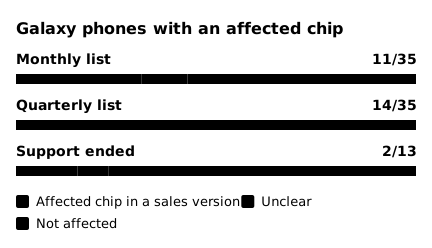
Samsung publishes a monthly list of models that get a security update every month and a quarterly list of models that get one every three months. As of November 4, safeuntil tracks 83 Galaxy phones, and 70 of them are on these lists. Of these 70 phones, 25 have a sales version with an affected chip. That is 11 of the 35 phones on the monthly list and 14 of the 35 phones safeuntil tracks on the quarterly list. The quarterly list also has phones that safeuntil does not track, mostly Galaxy M and F models, and this post does not cover them. The table lists only the versions whose chip I confirmed from a chip name Samsung published or from the CPU specs on Samsung Korea's support pages.
| Model | Chip | Confirmed versions | Update list |
|---|---|---|---|
| Galaxy S23 FE | Exynos 2200 | Korea, Europe | Monthly |
| Galaxy S24, S24+ | Exynos 2400 | Korea, Europe | Monthly |
| Galaxy S25 FE | Exynos 2400 | Korea, US, Europe | Monthly |
| Galaxy S26 FE | Exynos 2500 | Korea, US, Europe | Monthly |
| Galaxy Z Flip7 | Exynos 2500 | Korea, US, Europe | Monthly |
| Galaxy Z Flip7 FE | Exynos 2400 | Korea, US, Europe | Monthly |
| Galaxy A54 5G | Exynos 1380 | US, Europe | Monthly |
| Galaxy A55 5G | Exynos 1480 | Europe | Monthly |
| Galaxy A56 5G | Exynos 1580 | US, Europe | Monthly |
| Galaxy A57 5G | Exynos 1680 | US, Europe | Monthly |
| Galaxy S22, S22+, S22 Ultra | Exynos 2200 | Europe | Quarterly |
| Galaxy A14 | Exynos 850 | India | Quarterly |
| Galaxy A14 5G | Exynos 1330 | India | Quarterly |
| Galaxy A16 5G | Exynos 1330 | US, Europe | Quarterly |
| Galaxy A17 5G | Exynos 1330 | US, Europe | Quarterly |
| Galaxy A25 5G | Exynos 1280 | Europe | Quarterly |
| Galaxy A26 5G | Exynos 1380 | Europe | Quarterly |
| Galaxy A33 5G | Exynos 1280 | Europe | Quarterly |
| Galaxy A35 5G | Exynos 1380 | Korea, Europe | Quarterly |
| Galaxy A37 5G | Exynos 1480 | US, Europe | Quarterly |
| Galaxy A53 5G | Exynos 1280 | Korea, US, Europe | Quarterly |
| Galaxy XCover5 | Exynos 850 | Europe | Quarterly |
| Galaxy A13 | Exynos 850 | Korea, US, India | Support ended |
| Galaxy Note20 Ultra 5G | Exynos 990 with Modem 5123 | Bangladesh | Support ended |
The last two rows are phones whose support has ended, so they are not among the 70. For the A14 and A14 5G, I found the affected chip only in the Indian versions. The European A14 5G uses a MediaTek chip. The Note20 Ultra 5G's Exynos 990 is not on the list, but Samsung Semiconductor says that chip works with Modem 5123, which is.
Your phone's model number, under Settings > About phone, tells you which version you have. The US Galaxy S24, for instance, is SM-S921U and the European one is SM-S921B. The US S24 uses a Snapdragon chip, so it is not affected. In countries not in the table, the same model can use a different chip. For example, the European S22 uses the Exynos 2200, but the Indian S22 uses a Snapdragon.
The S23, S23+, S23 Ultra, S24 Ultra, S25, S25+, S25 Ultra, S25 Edge, S26 Ultra, Z Flip4, Flip5 and Flip6, and Z Fold4, Fold5, Fold6, Fold7, Fold8 and Fold8 Ultra use Snapdragon chips in the US, Korea and Europe, so they are not affected. The Z Fold Special Edition and Z TriFold sold in Korea use Snapdragon chips too. The A05s, A27 5G, A36 5G, A73 5G, XCover6 Pro and XCover7 Pro use Snapdragon chips, so they are not affected either. The S21 FE uses a Snapdragon 888 or an Exynos 2100, and neither is on the list. The A04, A04e, A05, A06, A06 5G, A07, A07 5G, A15, A15 5G, A16, A17, A24, A34 5G and XCover7 use MediaTek chips, which are not on the list either. The S24 FE's Exynos 2400e and the Exynos 2600 in the Korean and European S26, S26+ and Z Flip8 are not on Samsung Semiconductor's list by name, so it is unclear whether they are affected.
The A13 and the Note20 Ultra 5G versions in the table also use an affected chip, but their support has ended, so they will not get the November update. On these phones the modem flaw stays unfixed. Plan a move to a phone that still gets updates.
When the November update reaches your phone
Samsung's bulletin announces which fixes go into the month's update. The update you install comes separately for each model and region. On November 4, I checked Samsung's release notes for each of the 70 phones on the update lists: none had the November patch yet. I used the Korean, European or US notes, and the Indian notes for the A04 and nine other phones.
From January to October 2026, counting each monthly-list phone in each month, half of the US unlocked updates came within 23 days of Samsung's bulletin. The median was 20 days in Europe and 16 in Korea. For each phone, I compared the first update that carried each month's patch level with that month's bulletin date. The median varied a lot from month to month: in the US, from about 9 days in April to 28 in August. The November bulletin came out on November 3. If November is a typical month, about half of the US unlocked monthly-list phones will have the update by around November 26.
Quarterly-list phones are updated at different intervals. The European S22's last three updates brought the February, May and August patches, on March 9, May 27 and September 3. If it keeps that three-month step, its next update brings the November patch. The August patch reached it 30 days after the August 4 bulletin.
Other fixes in the November update
 (open full-size image)
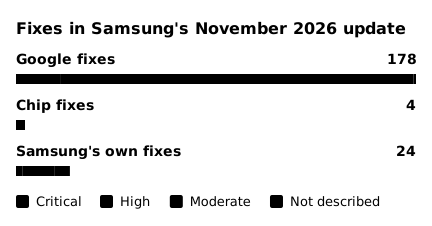
The November bulletin has 178 Google fixes, 4 chip fixes and 24 of Samsung's own fixes. Samsung published the number and description of only 17 of its 24 own fixes.
Of the Google fixes, 20 are rated critical. According to the Android Security Bulletin, the most severe flaw this month is in the Android framework and allows remote code execution with no extra privileges and no user action. CVE-2026-58704 is the only November fix in the October 30 version of CISA's catalog.
Check which November fixes your phone is missing
The Android phone pages on safeuntil ask for the Android version and security patch level shown in your phone's settings, count the known fixes for that Android version released after that patch level, and list up to 100 of them.
On November 3, I entered Android 17 and the security patch level 2026-10-05 on the Galaxy S25 page, a monthly-list phone. It counted 104 missing security fixes, all from November, and listed 100 of them. On the Galaxy S22 page, a quarterly-list phone, Android 16 and 2026-08-05 left 236 fixes missing, from September through November.
Chip fixes are not part of this check, so CVE-2026-58704 does not appear in the list. To see whether your phone has the November update, go to Settings > About phone > Software information. Samsung's bulletin lists the CVE-2026-58704 fix in its November release, and says that a phone showing SMR Nov-2026 Release 1 under "Security software version" has all of Samsung's and Google's November patches.
The October post shows where to find your patch level and how to install updates. If your model is in the table and on an update list, open Settings > Software update every few days and install the November update as soon as it appears. Do not put off the following month's update either.
Dates are as each source gives them: Google's bulletins in UTC, CISA's catalog in US time.
Sources
- Samsung Mobile Security, Security Updates SMR November 2026 (published November 3, 2026): https://security.samsungmobile.com/securityUpdate.smsb?year=2026&month=11
- Samsung Mobile Security, Security Updates Scope (checked November 3, 2026): https://security.samsungmobile.com/workScope.smsb
- Samsung Mobile, software release notes by model (checked November 4, 2026): for example the European Galaxy S24 https://doc.samsungmobile.com/SM-S921B/EUX/doc.html
- Android Security Bulletin, November 2026 (published November 2, 2026): https://source.android.com/docs/security/bulletin/2026/2026-11-01
- Pixel Update Bulletin, September 2026 (published September 15, 2026): https://source.android.com/docs/security/bulletin/pixel/2026/2026-09-01
- CISA, Known Exploited Vulnerabilities Catalog (version 2026.10.30): https://www.cisa.gov/known-exploited-vulnerabilities-catalog
- NVD, CVE-2026-58704: https://nvd.nist.gov/vuln/detail/CVE-2026-58704
- Samsung Semiconductor, Product Security Update CVE-2026-58704: https://semiconductor.samsung.com/support/quality-support/product-security-updates/cve-2026-58704/
- Samsung Semiconductor, Exynos 990 (the chip that pairs with Modem 5123): https://semiconductor.samsung.com/news-events/tech-blog/create-your-world-with-the-exynos-990-processor/
- Chips by model: Samsung Newsroom France, Galaxy S24 series https://news.samsung.com/fr/galaxy-s24-series; Samsung Newsroom Korea, Galaxy Z Flip7 https://news.samsung.com/kr/%EC%82%BC%EC%84%B1%EC%A0%84%EC%9E%90-%EA%B0%A4%EB%9F%AD%EC%8B%9C-z-%ED%94%8C%EB%A6%BD7-%EA%B3%B5%EA%B0%9C; Samsung Newsroom US, Galaxy S25 FE https://news.samsung.com/us/meet-samsung-galaxy-s25-fe-gateway-galaxy-ai-flagship-essentials/; Samsung Newsroom US, Galaxy A16 5G https://news.samsung.com/us/samsung-galaxy-a16-5g-galaxy-fit3-now-available-in-us/; Samsung Newsroom Poland, Galaxy A56 5G https://news.samsung.com/pl/galaxy-a56-5g-i-galaxy-a36-5g-z-awesome-intelligence-debiutuja-na-rynku; Samsung Bangladesh, Note20 specifications https://www.samsung.com/bd/smartphones/galaxy-note20/specs/; Samsung Newsroom India, Galaxy S22 https://news.samsung.com/in/samsung-galaxy-s22-series-to-be-powered-by-snapdragon-8-gen-1-in-india; Samsung Newsroom India, Galaxy A13 https://news.samsung.com/in/samsung-revamps-galaxy-a-series-unveils-five-new-smartphones-in-india; Samsung UK, S23 FE specifications https://www.samsung.com/uk/support/mobile-devices/specifications-for-the-new-galaxy-s23-fe; Samsung Ireland, S22 https://www.samsung.com/ie/support/mobile-devices/gaming-on-the-s22/; Samsung Switzerland, A53 https://www.samsung.com/ch/support/mobile-devices/vergleich-galaxy-a53-vs-a52/; Samsung Germany, A54 and A55 https://www.samsung.com/de/support/mobile-devices/vergleich-galaxy-a55-a54/; Samsung Germany, A16 5G and A35 https://www.samsung.com/de/support/mobile-devices/vergleich-galaxy-a16-5g-a35/; Samsung Korea, Galaxy S26 FE https://www.samsung.com/sec/smartphones/galaxy-s26-fe/; Samsung US, Galaxy S26 FE https://www.samsung.com/us/smartphones/galaxy-s26-fe/; Samsung Newsroom UK, Galaxy S26 FE https://news.samsung.com/uk/samsung-galaxy-s26-fe-delivering-the-latest-flagship-experience-focused-on-what-matters-most; Samsung US, Z Flip7 FE https://www.samsung.com/us/support/answer/ANS10006876/; Samsung US, Galaxy A57 5G https://www.samsung.com/us/smartphones/galaxy-a57-5g/; Samsung UK, A57 5G and A37 5G https://www.samsung.com/uk/support/mobile-devices/what-are-the-differences-between-the-galaxy-a57-5g-and-a37-5g/; Samsung US, Galaxy A37 5G https://www.samsung.com/us/smartphones/galaxy-a37-5g/; Samsung Newsroom India, Galaxy A14 https://news.samsung.com/in/samsung-launches-galaxy-a14-with-premium-design-50mp-triple-camera-and-5000mah-battery-starting-at-just-inr-12999; Samsung Newsroom India, Galaxy A14 5G https://news.samsung.com/in/samsung-launches-galaxy-a14-5g-and-galaxy-a23-5g-to-consolidate-5g-leadership-in-india; Samsung Newsroom US, Galaxy A17 5G https://news.samsung.com/us/samsung-welcomes-galaxy-a17-5g-galaxy-tab-a11-galaxy-ecosystem/; Samsung UK, Galaxy A25 5G https://www.samsung.com/uk/business/smartphones/galaxy-a/galaxy-a25-5g-blue-128gb-sm-a256bzbdeub/; Samsung France, Galaxy A series 2025 https://www.samsung.com/fr/guide-achat-mobile/comparatifs/samsung-galaxy-a-series-2025/; Samsung Slovakia, A53 and A33 https://www.samsung.com/sk/support/mobile-devices/porovnanie-galaxy-a53-vs-a33/; Samsung Newsroom UK, Galaxy XCover5 https://news.samsung.com/uk/samsung-announces-galaxy-xcover-5-the-latest-rugged-smartphone-built-for-the-toughest-environments; Samsung UK, Z Flip7 and Z Flip7 FE comparison https://www.samsung.com/uk/support/mobile-devices/galaxy-z-flip7-vs-galaxy-z-flip7-fe-comparison/; Samsung Newsroom UK, Galaxy A17 5G https://news.samsung.com/uk/awesome-made-easy-samsung-introduces-the-galaxy-a17-5g; Samsung Korea support pages by model https://www.samsung.com/sec/support/